

Chicken vs Zombies isn't your typical slot—it's a crash-style battle game where survival equals profit. But unlike passive spins, this game demands active engagement: every round you survive pushes your payout multiplier higher, while a single zombie bite ends your run instantly. This guide cuts through the spectacle and explains the real math behind the battle, how to manage your risk, and what "strategy" actually means in a game governed by chance.
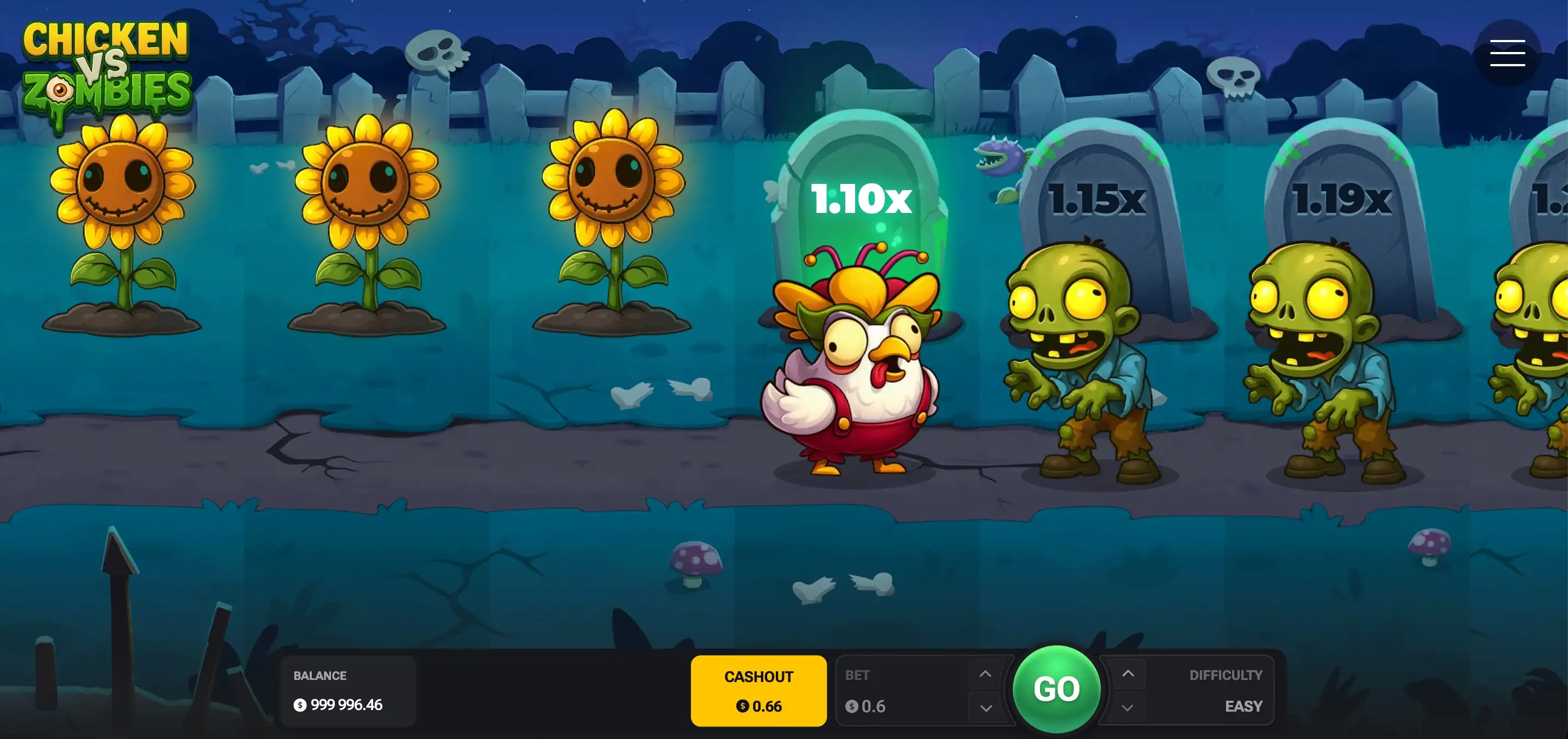
At its core, Chicken vs Zombies uses a crash game mechanic wrapped in thematic combat. You place a bet to start a round. A chicken character appears on screen, and waves of zombies begin their advance. With each wave survived, your multiplier increases—often starting at 1.01x and climbing rapidly (e.g., 1.03x, 1.06x, 1.10x, 1.15x, and beyond).

The critical rule: you must cash out before a zombie "bites" you. If you fail to cash out in time, you lose your entire stake for that round. There's no partial win—only full loss or full cashout at the current multiplier.
This structure makes the game highly volatile. Wins can be explosive, but losses are total and frequent. According to gambling math principles, such games typically have a built-in house edge of 4–10% or more, meaning your expected value (EV) is negative over time.
| Provider | InOut Games |
|---|---|
| Game Type | Crash / Battle |
| RTP | 95.5% |
| House Edge | 4.5% |
| Volatility | Very High |
| Stake Range | 0.01 to 200 per round |
| Max Win | Up to 870,000 RUB |
| Release Year | 2025 |
| Difficulty Modes | Easy (30 zombies), Medium (25), Hard (22), Hardcore (18) |
Chicken vs Zombies offers four difficulty presets that directly impact your risk-reward balance. Each mode determines the total number of zombies you must defeat to reach maximum multipliers, fundamentally altering both hit rate and payout distribution.
| Difficulty | Total Zombies | Risk Profile | Best For |
|---|---|---|---|
| Easy | 30 zombies | Lower risk, slower multiplier growth | Beginners testing mechanics |
| Medium | 25 zombies | Moderate risk, balanced progression | Standard sessions |
| Hard | 22 zombies | High risk, faster multiplier gains | Experienced risk-takers |
| Hardcore | 18 zombies | Maximum risk, exponential growth | High-variance hunters |
The game doesn't just test luck—it rewards calculated aggression. Easy mode with 30 zombies offers more frequent but smaller multiplier gains. Hardcore mode's 18 zombies mean each victory compounds faster, but crash probability increases exponentially. Choose your difficulty based on session bankroll and cashout discipline, not wishful thinking.
Don't confuse "action" with "profit." Chicken vs Zombies is designed for high engagement, not consistent returns. Two key metrics explain why:
In short: the game feels fast and rewarding due to constant visual feedback, but your bankroll can deplete rapidly if you chase big multipliers without discipline.
No. There is no strategy that overcomes the house edge in Chicken vs Zombies. Each round is governed by a Random Number Generator (RNG) using SHA256 server seed hashing combined with client seeds, ensuring every outcome is independent. Past rounds do not influence future ones—so "waiting for a big win" after a losing streak is a fallacy.
That said, you can manage your exposure:
Choose a realistic multiplier threshold (e.g., 2.00x or 3.00x) and stick to it. Automate it if the platform allows. Consistency beats emotion.
A $100 loss is not "recovered" by risking $200 on the next round. The house edge persists regardless of bet size.
If you have a $500 session budget, betting $50 per round gives you only 10 chances—too few for a high-variance game. Aim for 50–100+ spins within your session limit.
Use demo play to calibrate your cashout timing and understand multiplier behavior across difficulty modes before risking real money.
Early exits trade smaller wins for higher hit rate. Later exits chase bigger payouts with increased crash probability. Choose Easy mode for conservative play.
Let's simulate a 100-round session with a $10 bet per round ($1,000 total stake) on a game with 95.5% RTP (4.5% house edge):
| Cashout Target | Estimated Win Rate | Average Multiplier | Risk Level |
|---|---|---|---|
| 1.10x (ultra-safe) | ~85% | 1.08x–1.12x | Very Low |
| 2.00x (balanced) | ~50% | 1.80x–2.20x | Moderate |
| 5.00x (aggressive) | ~20% | 4.50x–5.50x | High |
Search for online casinos offering InOut Games titles. Verify the operator holds a valid license (e.g., Curacao, MGA, UKGC).
Create an account with valid email and personal details. Complete any required identity verification (KYC).
Launch Chicken vs Zombies in free play mode to explore mechanics risk-free.
Fund your account using a supported payment method. Start with small stakes (e.g., 0.10–1.00 per round).
Activate deposit limits, loss limits, and session timers in your account settings before starting real-money play.
No—if the operator uses a certified RNG and holds a valid license. However, "fair" doesn't mean "profitable." The 95.5% RTP ensures long-term losses.
Many platforms offer auto-cashout functionality. Use it to enforce discipline and avoid emotional decisions. Set your target multiplier (e.g., 2.00x) in advance.
This varies by difficulty mode. Theoretically, multipliers can grow extremely high, but hitting extreme multipliers (50x+) is astronomically low. The max win cap is 870,000 RUB.
It is competitive for the crash game category. However, RTP is a long-term average—short-term sessions can deviate wildly due to very high volatility.




El juego cuenta con un
sistema
El juego cuenta con un sistema de seguridad sólido, conocido com


